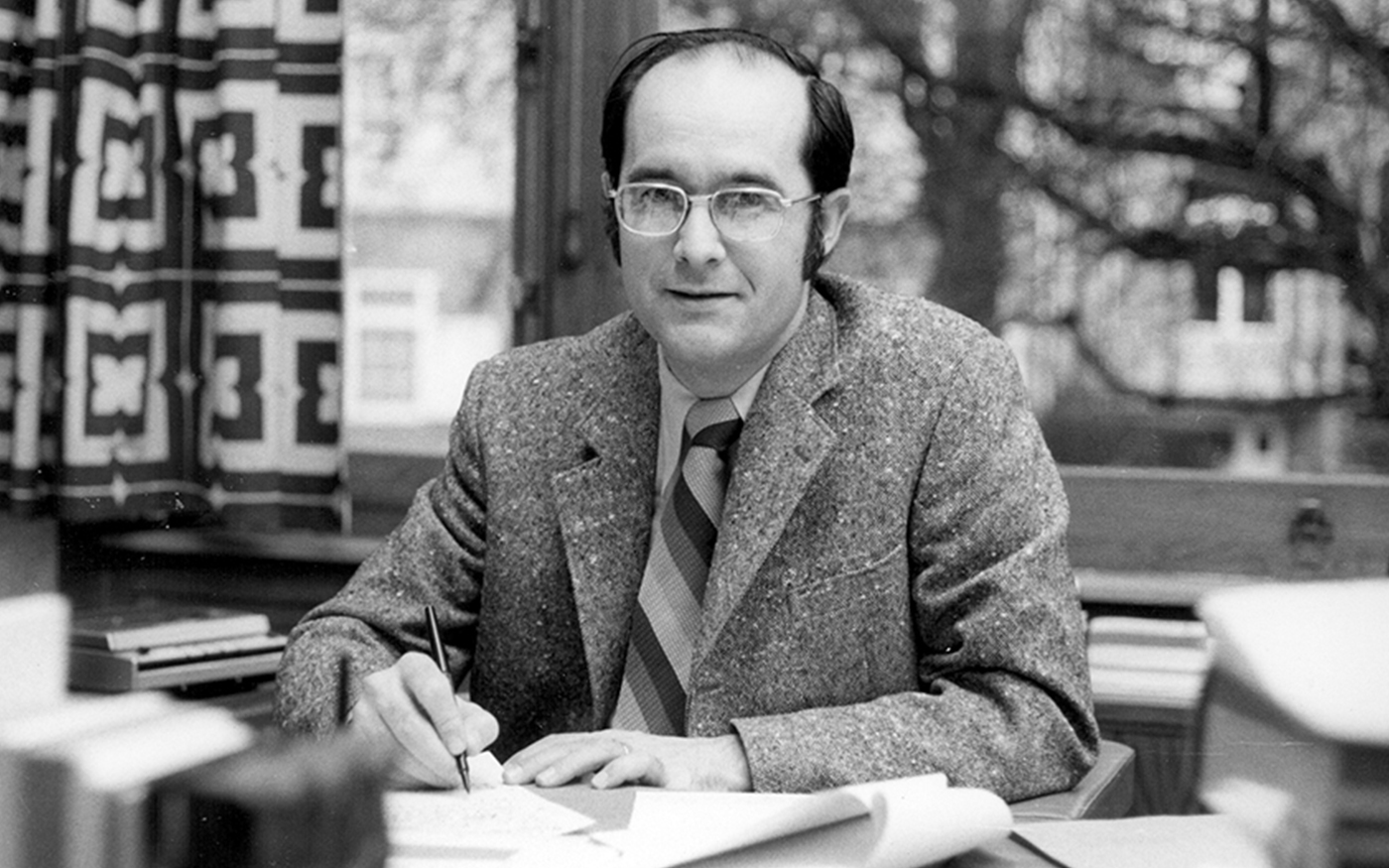
This Week in AG History — Jan. 23, 1972
In 1966, as Flattery was completing his doctorate in education, one of his requirements was to research and analyze different educational models. He contacted J. Philip Hogan, director of the Department of Foreign Missions (now Assemblies of God World Missions, AGWM), to inquire about conducting a project that might benefit the missions enterprise. Hogan approved Flattery’s proposal to travel overseas and survey the training needs of Bible schools around the world.
This research, combined with Flattery’s own experience as a missionary kid in Upper Volta (now Burkina Faso), where he had benefited from correspondence courses, led him to propose the idea of a global correspondence school. He presented his initial ideas to Hogan with a vision for standardized discipleship and ministerial training that could serve the worldwide Church.
Meanwhile, early in 1967, Charles Greenaway was asked to present at the annual School of Missions on the growing need for correspondence-based training on the mission fields. Several regions had already begun small national programs to disciple believers and train ministers, but these efforts were largely independent, with each country developing its own materials.
Greenaway reached out to Flattery to see whether his research might inform the presentation. Flattery enthusiastically shared both his findings and his passion for a unified global training model. When Greenaway later surveyed regional missions directors, their response was overwhelmingly positive.
Maynard Ketchum, field secretary for Southern Asia, wrote, “I think the great need is for a standardized course. Although illustrations must be ‘localized,’ the basic courses could be the same, and I think the Missions Department should take the initiative.”
Because of Flattery’s expertise in education, Hogan authorized him to develop a detailed plan for the Foreign Missions Committee that would “develop a worldwide correspondence training program where the church, at whatever level it finds itself, can be served, and that young people in any culture anywhere can have an opportunity to sound biblical teaching.” He was given $5,000 in Boys and Girls Missionary Crusade funds (now BGMC) to begin the work.
In August 1967 — just one month after presenting his proposal — Flattery was appointed president of a new school with no students, no curriculum, and no name. Though nontraditional educational models were already being used in some places, this moment marked the beginning of what would become an unprecedented advance in theological education. Flattery’s lifelong dream — to train Christians in all nations to reach the lost in all nations — was beginning to take shape.
Through his international experience and research in educational anthropology, Flattery became convinced that while cultures differ, people everywhere share the needs common to human nature. Building on that insight, he developed a core evangelism course, The Great Questions of Life, along with several discipleship courses on Christian living.
When the International Correspondence Institute officially launched in 1969, its fourfold mission was evangelism, discipleship, workers’ training, and degree-level theological education for believers around the world.
Working from cramped offices in “Mission Village” at Central Bible College in Springfield, Missouri, Flattery was joined by Carl Malz as academic dean and Louise Jeter Walker as assistant to the dean. Together they set an ambitious goal: to enroll 1 million students.
In the Jan 23, 1972, edition of the Pentecostal Evangel, Flattery’s article, “ICI Builds Churches,” was published. Drawing on reports from Mark Buntain in North India and Mark Bliss in Iran, Flattery demonstrated that ICI was not merely educating students but actively equipping pastors and fueling new church plants. He wrote that for the church to fulfill God’s purpose, it must be “enlarged, established, and extended,” adding, “ICI is devoting 100% of its personnel and energy to this end.”
By 1972, growth was so rapid that ICI relocated its international headquarters to Brussels, Belgium. The move strengthened the school’s global identity and strategic reach. Borrowing facilities from Continental Bible College, ICI staff began hosting training workshops and expanding into Bible-college-level coursework, drawing on professors from established institutions.
In 1991, ICI moved its international headquarters from Brussels to Irving, Texas, continuing its mission under the theme “From All Nations to All Nations.” In 1999, the institution returned to Springfield, Missouri, merging with Berean University to form Global University (GU).
By the time George M. Flattery passed away in 2025, the school that began as a doctoral research project had recorded more than 4.7 million personal decisions for Christ through its evangelism courses. Today, Global University operates through 205 offices in 166 countries, producing materials in 141 languages. Students have planted more than 116,000 churches and house churches, and over 20 million people have been impacted through direct study of GU courses.
Read George Flattery’s “ICI Builds Churches” article on page 22 of the Jan. 23, 1972, issue of the Pentecostal Evangel.
Also featured in this issue:
• “Add Life to Your Years,” by Russel Fornwalt
• “Praying in the Holy Ghost,” by Normand Thompson
• “BGMC Day 1972: A 20-year Milestone”
And many more!
Click here to read this issue now.
Pentecostal Evangel archived editions courtesy of the Flower Pentecostal Heritage Center.